|
ANSWER - Hand Of The Week - 02/01/03
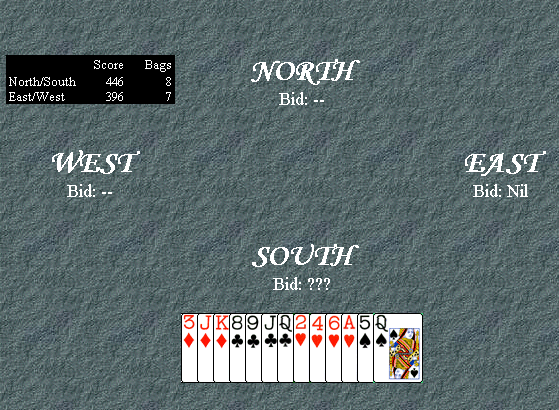
In first and second seat of endgame bidding, players should bid the actual value of their hands, thus leaving the decisions up to their partners. However, most hands are not cut-and-dry and there are always exceptions. The cards display a 2-3 bid, probably 3 with the nil opener by East. But is 3 the optimum bid for South?
With West's bid standing at an unknown, South really has no clue how best to bid/play this hand. East/West have 7 bags and the nil puts them out in front. That leaves North/South with three options, set the nil, bag the cover, or outbid East/West. South cannot know what is going to be the best approach from second seat. South can underbid and play to set nil/bag cover but his KJ3 D and QJ98C do not represent great bagging potential. Furthermore, West's bid may dictate an approach better than bagging. On the other hand, South has no clue what West and North might be bidding, bagging the cover may be the only option if North can't outbid or nil. Or North might just nil putting South in a position where he must avoid bags. South must make a bid that best supports all of these scenarios.
Keeping in mind North and South are both strong players, South decides to bid for max value. South can maybe take 5 with the nil on the board but opts for a 4 bid and mild safety. Now the nice thing about the 4 bid is it does not throw out the bagging option. North still has the last bid and will set the stage. If bagging is the only option he can underbid his hand knowing South is giving full value. If North opts to nil, South can cover effectively in the advantaged position and control bags at the same time. The 4 bid leaves North with the most clues on how South's hand is built and how to bid to win.
|