|
ANSWER - Hand Of The Week - 11/24/02
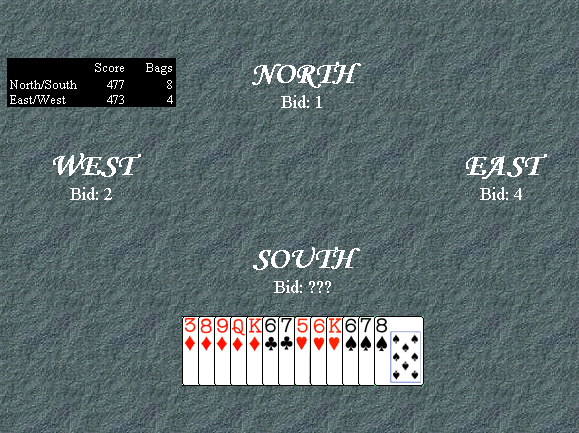
The first step here is obviously to evaluate the score and the bags. Assuming the opponents make their bid, they will have 533 points. With North's 1 bid South needs to bid at least 5 or nil to out-score the opponents. South's cards represent a maximum of 4 tricks (KQ Diamonds, K Hearts and a Spade ruff on a club). Taking five tricks with South's cards is very unlikely. The nil bid presents a possible opportunity, a nil is makeable although very risky. The other problem with the nil bid is the bag situation. The table bid is currently 7, leaving 6 bags available. If South bids nil it would be highly unlikely that North could cover the nil and only take 1 overtrick. At this point bidding nil is not a good option.
North and South may also attempt to delay the game. They can play defensively and play to bag East and West. South can either bid 1 or bid high such as 5 and play to bag the opponents and set their team's bid. This task would be very difficult since it requires East/West to take 12 total tricks.
Bluffing by bidding low or nil and attempting to set the opponents is the final option. In many scenarios it works but in this situation it would not pose much of a threat. North and South would need to take at least 8 tricks to set East and West. With North's 1 bid and South's 4 maximum, 8 tricks is highly unlikely.
After evaluating all the possible logical bids, JapaneseFreak Sensei recommends that South bids 5 and attempts to outbid the opponents and win the game. This seems to be the most reasonable option, although bleak. It is possible that North's 1 bid may yield 2-3 tricks and South's 5 bid may yield 3-4 tricks making just enough to win the game.
|